
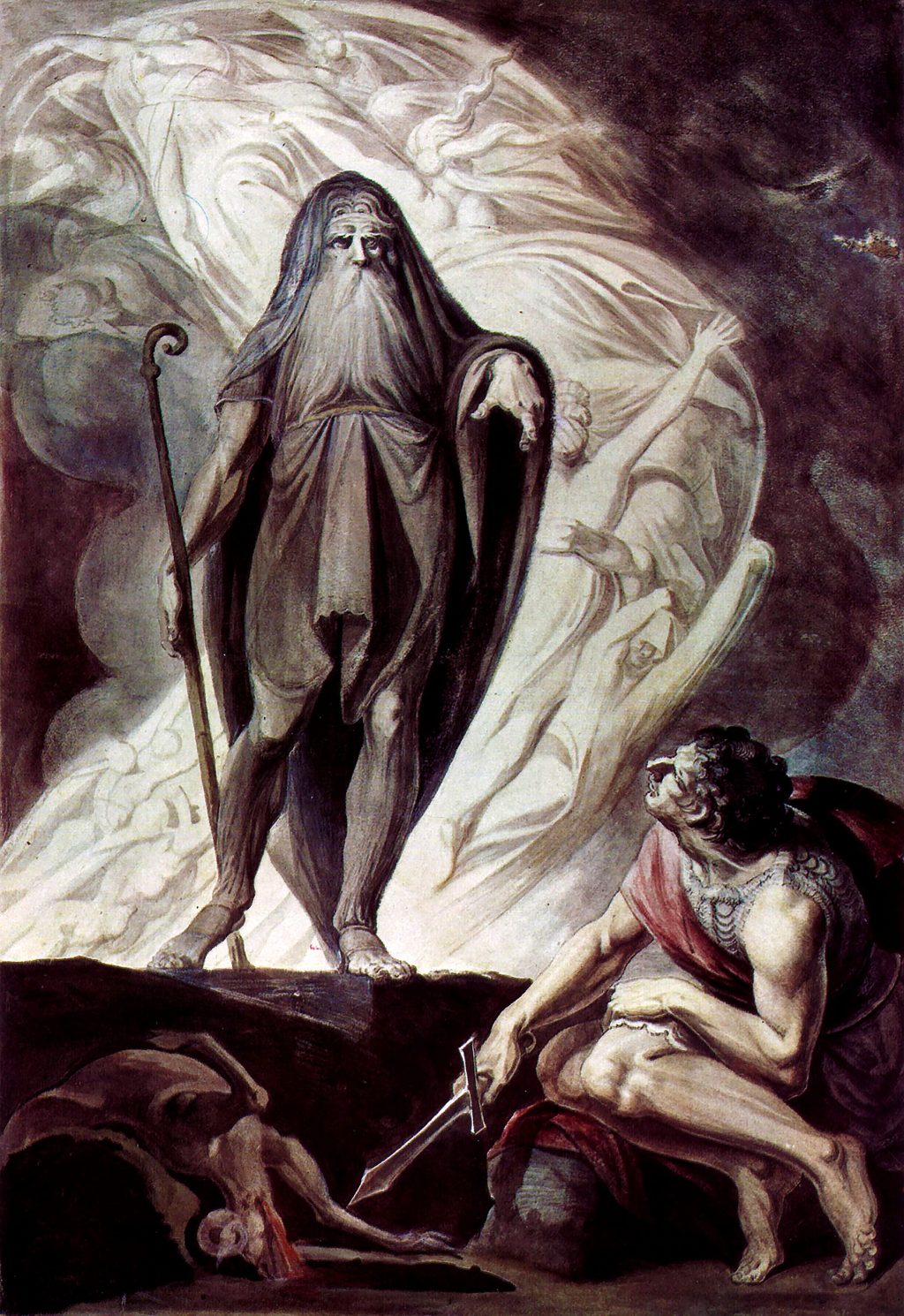
Henry Fuselli’s painting Teiresias Foretells the Future to Odysseus (oil on canvas), depicted below, displays the frightful moment in Book 11 of Homer’s Odyssey when Odysseus, under the order of Circe, descends among the dead in order to speak with the shade of Teiresias. The work perfectly captures the ethereal qualities of the spirits as they fly upward and curl back on themselves, in coils of agony and desire. The spectres in the background hold a far more ghostly form in comparison with Teiresias in the middle ground, who holds a more physical form, as if he could actually drink and eat the blood and oats Odysseus offers, playing with the ambiguity Homer maintains about the dead and the shape they take. In the foreground, tucked closest to the viewer, Odysseus cowers in fear, straining to look at the shades despite his terror. His sword, normally a mighty brand displaying a warrior’s courage, seems stunted, as if Fuselli is diminishing the prowess of the crafty Odysseus in the face of the dead.
Fuselli’s ability to maintain the ambiguity of the form of the dead begs the question of the nature of the dead. Homer himself remains vague on the subject, never quite verifying whether these warriors and brides have a physical shape or merely a spectral one. Homer gives certain attributes of physicality to these dead in that they are able to shout, they wear armour, and they are (presumably) able to partake in the physical offering Odysseus has provided. However, the epithet used most commonly in reference to the dead is “strengthless heads,” suggesting some degree of impotence in the physical realm. Further, Elpenor, the comrade of Odysseus who perished on Circe’s Island states, “…my ghost went down to the house of Hades” (Book 11, 65), making specific use of the term ψυχή, meaning soul or spirit. Elpenor later beseeches Odysseus, “Do not, when you depart, leave me behind unwept and unburied…” (Book 11, 74), implying that his body remains elsewhere. Thus, it would appear that the shades in Hades are just that, shades. Yet even still, they have physical capabilities and seem also to have a fear of physical harm, as Odysseus must fend them off with his sword, a seemingly useless instrument against mere spectres.
Fuselli’s Teiresisas seems to be much more of a physical manifestation than the ghostly apparitions swarming around him. He stands in contrapposto, with robes that weigh on his limbs and seem to rest on living sinews. Meanwhile, the spirits around him lack gravity, and their robes, while responding as if with some weight, are significantly less grounded, whipping about their frail forms. This persistent ambiguity regarding the place of the dead leads to a meditation on the role of the dead overall. The contrast between Teiresisas and the more general dead around him distinguishes the sought after and thought about dead from those dead who have sunk into anonymity. The dead seem to become something of substance when they are needed, when they are summoned, while they remain in a limbo of obscurity the remainder of the time. Fuselli’s work perfectly encapsulates this. He grounds the spirit of Teiresias, the one whom Odysseus seeks, and leaves the rest airy and unfounded as they are not the immediately sought after, thus they are relegating them to the ethereal.
Homer too, seems to imply this with the offering that Odysseus makes. While he honors all the dead, he offers specific libation for Teiresias, who, in turn, takes on a more physical form and is even able to drink of the blood prepared for him, “…when he had drunk the dark blood, then the flawless seer spoke to me…” (Book 11, 99). This incarnation continues as Odysseus goes on to question other members of the dead, not out of necessity, but out of desire. As each approaches the pool of blood, they take on a shape more like the living, because the blood is offered for them. It is, perhaps, representative of Odysseus’ desire to commune specifically with those individuals. Thus, because they are needed and remembered, they are more like the living, as though the need for them acts as the blood that rejuvenates them and they are, in turn, able to partake in physical actions such as drinking.
Perhaps this contributes to Elpenor’s desire to be buried and remembered, not for the sake of glorious deeds as is the commonly proffered idea of immortality for mortals, but out of the fear of becoming more spectral, of fading into a general collection of spirits, without maintaining identity. This may be the true punishment, not only to fade into obscurity among the living, but to fade into obscurity among the dead as well and thus become less of what one was, as though one’s spirit, as well as one’s name, might diminish with the passing of time and with the languishing of memory. In this way, the concern for immortality not only relates to the remembrance of their names among the living, but directly informs the existence of their souls in the afterlife.
Turning from this interpretation of the afterlife to the relationship it holds with the living, the need for notoriety becomes significantly more crucial, as it directly influences one’s eternal being. Odysseus, both in Fuselli’s depiction and in Homer’s tale, clings to his sword, as something that is both reliable and as something by which he may gain remembrance. Thus, by brandishing his sword, he not only fends off the dead whom he fears to join, but he clings to the one thing that may offer him renown. His sword becomes the tool by which he may gain glory and stake his claim in memory, but may also establish a permanence for his soul in the afterlife, for if he sets a name for himself, he will be remembered as well as needed, as there would likely be others who would descend among the dead (κατάβασις) to seek his counsel (which, of course, is seen in Virgil’s Aeneid). In this manner, the thing which he accomplishes, communicating with and honoring the dead, is also the thing that would save him from the fate Elpenor fears, namely a fading of the spirit, even in the afterlife.
Fuselli’s Teiresias Foretells the Future to Odysseus draws on the linguistic and religious traditions found in Book 11 of Homer’s Odyssey by demonstrating the spiritual existence of the dead and their relationship with the living. He simultaneously represents an afterlife of ambiguity and notoriety, suggesting, in addition to the text, varying levels of existence for the soul in the afterlife. Fuselli also casts light onto the fear of diminishing spirit apparent in Odysseus while presenting him as achieving the one thing that might save him of this fate, remembrance and honor of the dead.

Henri Fuselli, oil on canvas, circa 1800, Cathays Park, Cardiff, Wales

 The Locus
Leave a comment