
Elias Sammoury
Within the tradition of Greek mythology and its dalliance with religion (whether in practice or simple association) there is an emphasis on the ecstatic. Far rivaling the contrivances of other religions and their supposed ecstatic encounters through visionaries, the Greek Bacchic rites depict mad joy; a razor’s edge of pastoral paradise and violent frenzy. Perhaps its situation in Greek culture mirrors the condition of man, balancing a notion of the rational with the animalistic. Less obviously, however, there lies a correlation between an experience of ecstasy and an experience of Beauty. Illustrated in the myths of Bacchus, from his unconventional birth through to his cursing of Pentheus in the title play by Euripides, the magnificence and wonder of the sublime, closely correlate with the Bacchic revelry and orgiastic situations of the mystery cult. Even the consideration of ” σπαραγμός” (sparagmos,), the rending of a living creature by bare hands in sacrifice, may be symbolic of an experience of the sublime. Edmond Burke, in his work “A Philosophical Enquiry into the Origins of Our Ideas of the Sublime and Beautiful” establishes the sublime as:
The passion caused by the great and sublime in nature, when those causes operate most powerfully is Astonishment, and astonishment is that state of the soul in which all its motions are suspended, with some degree of horror … No passion so effectually robs the mind of all its powers of acting and reasoning as fear. For fear, being an apprehension of pain or death, operates in a manner that resembles actual pain. Whatever therefore is terrible, with regard to sight, is sublime too … Indeed terror is in all cases whatsoever, either more openly or latently, the ruling principle of the sublime.
By this consideration of the sublime, Burke later introduces that the beholder of the sublime recognizes the danger of that which causes the astonishment and yet is far enough removed from the danger itself to be able to appreciate its cause. Thus, one may view a storm at sea and recognize the venom of the storm and the threat posed by it and yet appreciate the awesome might of the storm, due to the viewer’s distinct physical situation in relation to the storm. In this way, the sublime holds an aspect of beauty and simultaneous terror, thus denoting a danger and fear of the thing which is majestic or beautiful.
So as with the sublime, the Bacchic revelry holds a similar sway. While the sublime has its aspect of beauty or majesty, the Bacchic frenzy has its character of ecstasy and joy, while subliminally holding tenants of violence and massacre. The parallel of the Bacchic frenzy and the sublime is apparent in the dichotomy of the experience. Just as there is terror mingled with beauty or awe in the sublime, so too, is there joy and violence (perhaps not so distant cousins of terror and beauty) in the ecstasy of the Bacchanal.
The inception of Bacchus (Dionysus) illustrates, from an early perspective, the exposure to the sublime. Semele, the mother of Bacchus and lover of Jupiter, witnesses Jupiter in his full glory and is instantly obliterated. This exposure to the majesty of the god may be considered as a recognition of the sublime. The form Jupiter takes when impregnating Semele holds the potential of destroying her, and, as she is warned by him not to view his full form, she is subsequently aware of the terror and might and yet curious or appreciative of the beauty. In this manner, Jupiter holds the qualities of the sublime.
With the story of Semele and Jupiter is the first violence that Bacchus incites. Bacchus, at this point just conceived, is already the god of the vine and cluster and the mysteries of his Bacchanalia, while not yet enacted, are present in his potential. Thus, the ecstasy that is inherent with the worship of Bacchus and leads to the violent frenzy, is present in its potential at the conception of Bacchus. Furthermore, all the traits of the frenzy are also present at his conception and enacted upon Semele. The ecstasy of the love of Jupiter as well as the violent end that awaits are all mirrors and prototypes of Bacchic ritual and its ensuing frenzy. This initial episode in the life of Bacchus demonstrates the parallel between the sublime and the ecstatic, as it holds both the qualities.
The Greek Tragedian and playwright Euripides illustrates the correlation between the ecstatic frenzy and the sublime both in relation to those who experience the frenzy and in relation to the god himself. The wisdom of Tiresias and Cadmus pave the way for an understanding of the sublime in the play. Tiresias, in an effort to compel Pentheus to worship the new god Bacchus, tells him of Bacchus’ beginnings, of his gifts, and of what he brings. Tiresias recognizes the honor and might of Bacchus and similarly recognizes his fury as he warns Pentheus, “…but beware Lest Pentheus bring grief to thy house, O Cadmus. I do not speak in prophecy, but judging from the state of things, for a foolish man says foolish things” (366-69). Tiresias denotes the sublime in his decision to worship Bacchus, recognizing the threat if he does not. Thus, the self-preservational aspect of the sublime is apparent as well as the recognition of might (or astonishment) from a distance.
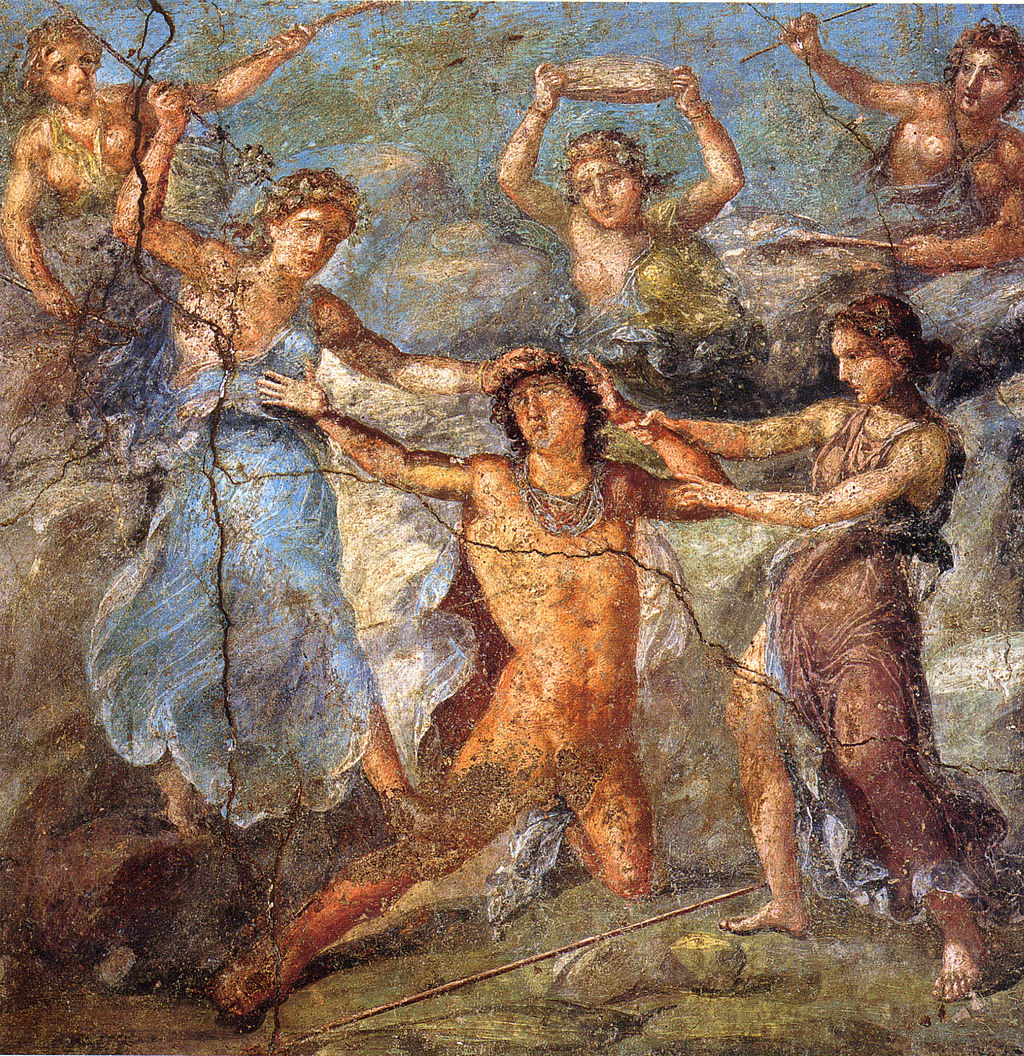
Finally, inherent in the situation of the ecstatic frenzy of Bacchus is the central right of sparagmos. Sparagmos consisted of the ritual ripping apart of a living being by hand, as demonstrated by the Maenads near the close of the play. The act of sparagmos fully links the situation of the sublime with the ecstatic revelry of the Bacchanal. If the sublime is the awareness of the danger and its might or beauty, then to perpetrate the violence in honor of the god, which is the might, is to partake in the situation of the sublime. To be so close to the danger of the situation and to be aware of it, as to be the agent of the danger and yet in fulfill it for the glory of the might, in this case a god, fully unites the sublime and the ecstatic. In this way, the Maenads participate in the sublime nature of the god and become, in themselves, sublime.
The death of Pentheus, as he is ripped limb from limb, adds a secondary level to the role of the sublime in the play. The sublime is both acted upon, in the case of the Maenads, and received, in the case of Pentheus. Pentheus is aware of the potential danger of the god, as he has been warned by Tiresias, and yet, unlike Tiresias, he succumbs to the potential danger of the sublime (in this case represented by the frenzy of the Maenads) and the danger is realized.
Throughout the Bacchic rites, as well as Euripides’ Bacchae, the sublime is apparent. It appears as a fear of the god and the might of the god as well as repercussion of the object of the fear. Pentheus receives the full might of the sublime, as it acts upon him, while the sublime is enacted through the Maenads. The sublime is inextricably bound with ecstatic through the view of the Greeks.
 The Locus
Leave a comment