
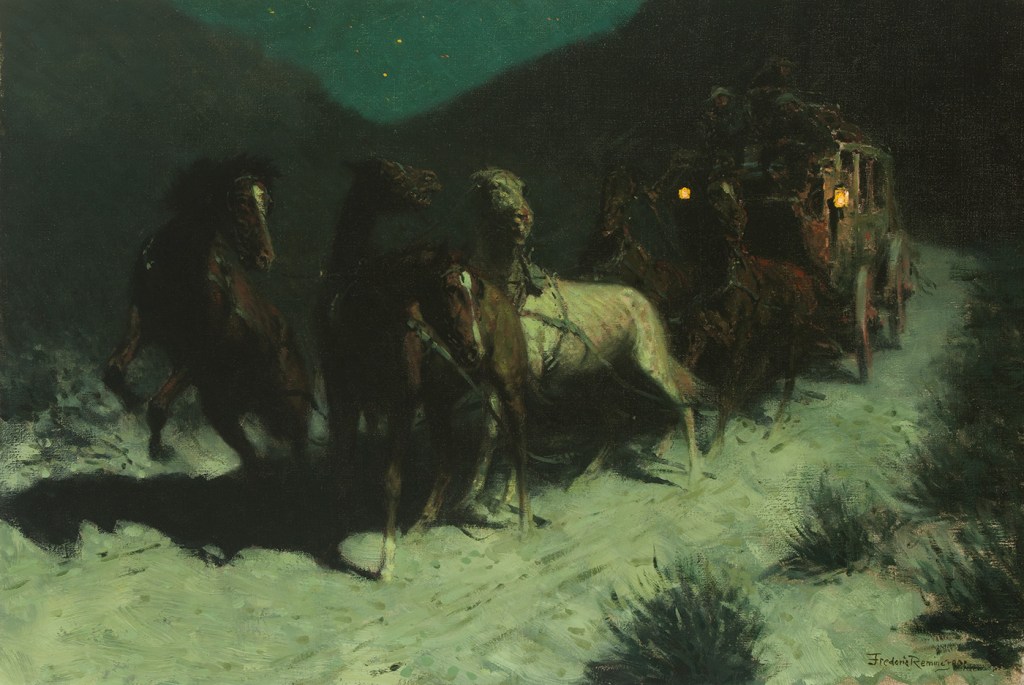
It is no longer in vogue to romanticize about the West as one would have even ten or twenty years ago. “Cowboys and Indians” is no longer an accepted genre and is viewed as always hateful. This time period is mostly viewed as a brutal period of American expansion. Contemporary Western movies are often bleak. The only mainstream and popular exceptions to this is in country music like Toby Keith’s “I Should’ve Been a Cowboy” or in video games like Red Dead Redemption 2, where there is still some romance for the idea of the West. When we lose a romantic sense of the West, it plays into a larger post-modern wave of viewing history, and we, as Americans, grow one step further from our own identity.
A romantic view of historical periods differs from our current journalistic reading. In many cases, a romantic reading gives us a better sense of history and folklore by opening the minds and dreams of those who lived it. When we look back at a less developed time in history and only see the dark reality, we forget what moved people through that time. History is always recorded by someone. There will always be a perspective, whether we realize it or not. This is not to underplay the bad and ugly historical facts of the time but to frame them in a light that tells a narrative, or even better, a narrative that can focus our lives on good aspirations.
So what is the Romantic West saying and why should we care? Below is a snapshot of what the Wild West can offer:
Nature is grand
Broadly speaking, the magic of America’s landscape is hollow at this point of our nation. Not that the landscape has so drastically changed, but we are mostly unable to realize what we have. Many of us think nature is beautiful because we see it as beautiful. Naturalism has slipped into the psyche by an overly scientific explanation of the world. When mountains form by tectonic shifts alone, rather than by God through tectonic shifts, beauty stops being intrinsic and is “in the eye of the beholder”.
Compare this view to Master’s Call by Marty Robbins, or Ghost Riders in the Sky. These songs are about deeply spiritual experiences that are married to grand images of the West. A cloud of devilish cowboys, or a tree that turns into a cross when lightning strikes it, is indicative of a world where the natural is also supernatural. An agnostic might say “I see spirituality in nature more than in the idea of God”, where these songs make a much bolder statement: “God is in nature.”
We see similar ideas, often without religious tones, in many aspects of visual art. Mark Maggiori is a western painter, residing in Arizona. His works are partially known for the vivid clouds he paints. Any subject he paints feels small under the scale of the clouds while at the same time made great by their unity with nature. Mark is not painting a realistic scene as a scene through a camera. He’s painting the supernatural landscape of the West as seen by those who are raptured in it. Mark and others, like Frederic Sackrider Remington, will use similar techniques like shifting the horizon or changing the color scheme to demonstrate supernatural elements of nature.
Discomfort can be noble.
Jeremiah Johnson is a movie about a mountain man (played by Robert Redford) and his struggles to survive in the Rocky Mountains. One might describe his life as exhausting, difficult, or near impossible. The amount of suffering and hardship he endures is comical. However, he actively chooses this life. Every accomplishment is made so much greater by the difficulty of achieving it. Every accomplishment is also followed by another hardship, and the cycle repeats.
Yet he chooses this life. These moments are interspersed with beauty and serenity. As much as we try to avoid all difficulty, the West is a reminder that by embracing difficult moments we can reach for greater virtue. Think of the trope where a bunch of cowboys fall asleep on the rough ground next to a fire. A bed would be much more comfortable but they can’t drive cattle from the bunkhouse. Greatness doesn’t come to one while laying in bed. When they are sleeping on the ground, they are active participants in life. To achieve a greater goal they can put up with discomfort.
American Chivalry
Every country in the Americas is far too young to have a historical mythos. Our European counterparts have the Roman Empire, Knights, and the sack of Troy. These are stories of Piety, Honor, and Chivalry. While our history is more matter-of-fact, we quickly lose stories that help us approach virtue the way a knight slaying a dragon helps. The Wild West is arguably the best time in our history to have an American mythos.
The cowboy often takes on characteristics of medieval knights. Again, a Marty Robbins song called Utah Carol is a great example of American chivalry. It’s a song about a ranch worker who saves a young girl from a stampede when she falls from her saddle. Robbins sings:
But the weight upon the saddle had not been felt before
His backcinch snapped like thunder and he fell by Lenore
Picking up the blanket he swung it over his head
And started cross the prairie, “Lay still Lenore, ” he said
When he got the stampede turned and saved Lenore his friend
Then turned to face the cattle and meet his fatal end
His six gun flashed like lightning, the report rang loud and clear
As the cattle rushed and killed him he dropped the leading steer
This story could have been told a thousand different ways. However, it is told romantically to rapture the listener in the nobility of the moment, the sacrificial love for Lenore, and the duty of Utah.
No matter what background someone comes from, romanticism can evoke emotions and help the viewer internalize some love for the world we live in. Throughout our daily routines, we can fall into uninspired and viceful lives. It’s better to read a good story, watch a good western, listen to a good ballad, and hopefully be moved in a better direction than where we were going.
 The Locus
Leave a comment