
“…isn’t this why the rearing in music is most sovereign? Because rhythm and harmony most of all insinuate themselves into the innermost part of the soul and most vigorously lay hold of it in bringing grace with them…” -Plato’s Republic, Book III
Man has a basic need and desire for ritual, an inherent tendency towards those things that are set aside from our daily routine. In former days this need was filled by the recitation of poetry, the spectacle of banquet, and the solemnity of religious ceremony. Now, we associate poetry with politics, banquets with conferences, and solemnity with Puritanism. The reality of these situations has been lost and most, if not all three, are now considered “boring,” “old fashion,” and in some cases, “superstitious.” Even in certain Christian circles, anything too reminiscent of the most primal need for ritual is deemed pagan.
Despite the criticism, the instinctual need for ritual persists and seeks fulfilment in our modern age. For those who still subscribe to such “old fashion” notions as traditional Christianity, indeed for those even who appreciate the need for occasion, regardless of religion, there is one particular author who has stumbled upon a situation for ritual.
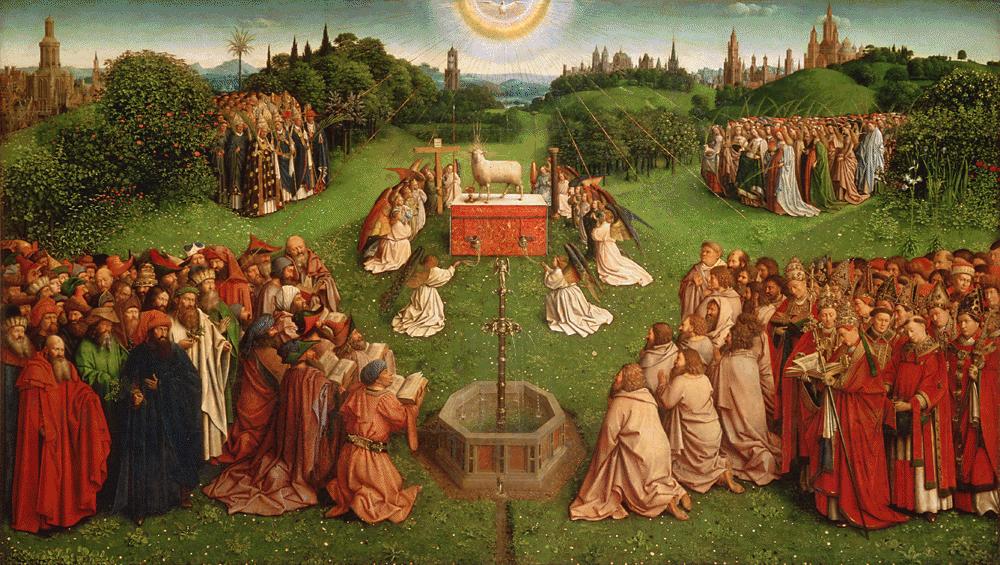
In my recent undertaking of C.S. Lewis’ Preface to Paradise Lost, I have come upon a particular section that has irrevocably changed my personal participation in the Catholic Mass, inviting me to enter more fully into the occasion of the mass and fulfilling my desire for ritual. The Christian Apologist, addressing a particularly pagan element, has nevertheless haunted me in every mass I have attended, from the quick and quiet thirty minute daily masses with a sleepy presider and sleepy congregation, to the extravagant solemnity, with booming organ and seraphic choir. He has taken two traditional rites and used one to inform the other, simultaneously adding gravity and appreciation to both. Lewis has, through the criticism of Epic Poetry, instilled a new reverence, a new joy, a new wonder for the poetry and divinity of the Catholic Mass. Lewis’ treatment of the influence of the form of poetry on the function of the poem carries directly to the form of the mass and its influence on the function of the mass.
The Catholic Mass, frequently derided for its formality and repetition, is, perhaps, one of the last true bastions of proper occasion, proper ritual. However, we rarely take the momentous situation into account, relegating it to something that simply must be gotten through. The mass becomes a trifle. We attend every Sunday, go through the motions, say the words, and have donuts. What difference is there between the repetition and formality of the mass as to that of going to the dentist (excepting the donuts)? The mass, like the dentist, becomes something to be gotten done; it is reduced to “mere formality.” Even the phrase “formality” carries with it a connotation of the irrelevant. It is out of the ordinary, but it is insignificant.
In his Preface to Paradise Lost, Lewis begins with a classification of Epic Poetry, establishing an historical and social context through which the epic may be received by a modern audience, with some degree of the honor and station it enjoyed in the palaces of Greece and the mead halls of the Angles. He notes that Epic Poetry, first and foremost, is performative. It is intended to be heard and heeded, a work of spectacle as well as oration. Lewis explains that the performance of Epic Poetry was recognizably different. It was proper to the occasion, and so, because it was not intended to be a part of the normal events, it was set apart, different, yet different in a way that was recognizable as being special. Lewis uses the Middle English term “solempne” to illustrate his point. Pointing out its similarity to “solemn,” he clarifies, “Like solemn it [solempne] implies the opposite of what is familiar, free and easy, or ordinary. But unlike solemn it does not suggest gloom, oppression, or austerity.” While we, as a modern audience, tend to associate the idea of “solemnity” with those occasions which are grave and serious, Lewis demonstrates that solemnity, in fact, refers to a more joyous occasion, making the distinction by saying “Feasts are, in this sense, more solemn than fasts. Easter is solempne, Good Friday is not.”
Lewis continues in this manner, moving from the idea of “solemnity” to that of “pomp,” maintaining that the two are proper to each other. He informs us that, in an attempt to regain an accurate understanding of solemnity “…you must think of a court ball, or a coronation, or a victory march, as these things appear to people who enjoy them…” Pomp, taken with solemnity then, is no display of gaudy ostentation but a demonstration of regality or due celebration relegated for the “proper occasion.”
Already, this wonderful understanding of pomp and solemnity should take root in the idea of the mass. Certainly, the mass is not celebrated for the demonstration of garment and gold, but for the message and sacrifice in which it participates. Similarly, the action of the Epic Poem may be retold outside of the form, but something is inherently missing. Meeting someone who has read a wonderful book and tells you about it, gives you an insight to the book but leaves with no emotional or thoughtful response. It does not grip you, it simply informs you. You are a spectator to the story, not a participant. So too, the mass, without proper appreciation of the form, becomes informative, not participatory. However, as one engages with it, as one delves into its mystery, its occasion, the mass becomes heightened by the sensory element of garment, gold, and incense, elevating the sensory in order to direct the spiritual. The form of the poem influences the function of the poem; the form of the mass, influences the function of the mass.
Lewis draws a distinct line between the ordinary and the extraordinary aspect of the poet, stating,
If we had seen the poet, first ordered to get up and take his place in a comic and indecent ballet, and then, seated and honoured with wine and spontaneously beginning his tragic lay at the inner prompting for a goddess, we should never again forget the distinction.
In place of the poet, let us place the priest. Instead of the spurring of a goddess, the corporeality of a God and His sacrifice, repeated outside of time. Just as the audience of the poet is taken immediately into the action of the story, and fully participates with form of the work, aided by the sing-song chant, the musical accompaniment, and the honoured place of the otherwise ordinary poet, how much more the congregation, exiting their daily life to participate in an out-of-time reality, aided by the senses and setting aside of the ordinary, in favour of something that is recognisably different and yet still recognizable? This, then, is the application of “solempne,” that which is different, yet recognizable in its proper station, and “pomp,” the sensory element that aids in the participation with the occasion and sets it above the ordinary course of events.
The correlation of Lewis’ introduction to the epic and the momentous occasion that is the Eucharistic celebration, reminiscent of the “coronation” or “victory march” that Lewis associates with the proper understanding of pomp and solemnity, is the inherent necessity of the spoken word. This word is not merely an equal component of the occasion of poetry (or the mass) but is, in fact, the focal point. The word of the poet is the substance of the poem, all else being secondary. Similarly, the word of the liturgy brings about the climax of the mass in the transubstantiation of the Eucharist. It is word, then, that is at the heart of these two rituals. Lewis notes that, in order to carry the momentum of the occasion, the language must be specific and partake in a “Poetic Diction,” reserved to the event.
Firstly, Lewis explains that “The unexpected tires us: it also takes us longer to understand and enjoy than the expected.” This holds significance with Epic Poetry, in that it explains the frequent “stock phrases” employed. The epigraphs for characters in Homer, such as “swift-footed Achilles,” not only help the poet to recall his lines, but enable the listener to enter into the poem more fully. If everything were novel in a poem, nothing would be recalled, due to the shock of novelty following novelty. As Lewis puts it, “A line which gives the listener pause is a disaster in oral poetry because it makes him lose the next line.”
In regard to the mass, there is a strong element of repetition. The mass repeats the same phrases week to week, day to day. It does not change, for if it did, it would lessen in its significance. The truth of the mass is revealed in its constancy. Similarly, the truth of the epic is illustrated through its repetition. By not constantly shocking the audience with novel ingenuities and clever turns of phrase, the audience is more readily able to focus on the overall theme of the epic, whether that be the anger of Achilles, the humility of Priam, or the courage of Beowulf. In the mass, the consistency of specific language allows the participant to focus on the metaphysical whole of the liturgy. There are a number of “stock phrases” that are repeated throughout the mass, perhaps most notably, “peace be with you.” While there is certainly a spiritual importance, there is also a linguistic importance. This repetition recalls the wandering mind and cues the participant into the specific part of the mass. It invites them not only to be receivers of the mass, but to share in its celebration.
Secondly, Lewis addresses the specific language that is to be used in the epic, “The language…must be familiar in the sense of being expected,” as has been noted. He goes on to say, “…in Epic, which is the highest species of oral court poetry, it must not be familiar in the sense of being colloquial or commonplace.” Here, Lewis harkens back to the solemnity and pomp of the occasion, not in reference to the physical disposition, but in regard to the oral presentation. Thus, the mass, like the epic, is a celebration that is not only extraordinary based on setting and spectacle, but based upon the import of language. The language must necessarily match the occasion, as it denotes the magnificence of the subject (perhaps represented by the persistence of Latin, in the case of the liturgy). These two considerations, the use of repetition and a vocabulary that is apart from the commonplace terminology, combine to form what Lewis refers to as “Poetic Diction.” This diction is a language that “is familiar because it is used in every part of every poem, but unfamiliar because it is not used outside poetry.” In fact, as an example, Lewis uses the liturgy itself, “Regular church-goers are not surprised by the service- indeed, they know a good deal of it by rote, but it is a language apart.” The “poetic diction” of the church mirrors that of the poem, used only in the specific situation of the liturgy, yet entirely familiar to those who attend. It would sound out of place, silly even, out of the liturgy, but it is entirely proper to its position and informs the congregation that they are partaking in something momentous, something that is out of the everyday, in the case of the Mass, something otherworldly.
Lewis’ insight to the elements and composition of Epic Poetry, in his attempt to illustrate the relevance to we poor moderns, throws a specific clarity, not simply upon the craft of poetry, but upon the beauty of the Mass. The magnificence and supernatural reality inherent in the Mass is heightened by the “poetic diction” and dignified language as well as the solemnity of performance. As the eloquence of the poetic manner induces the audience of an epic into the emotion and truth of the poem, the poetry of the Mass mirrors the divine beauty of the Eternal Logos through the elevation of the temporal word, inviting the congregation to participate more fully in the metaphysical reality of the Sacrifice.
 The Locus
Leave a comment