
Dear Reader,
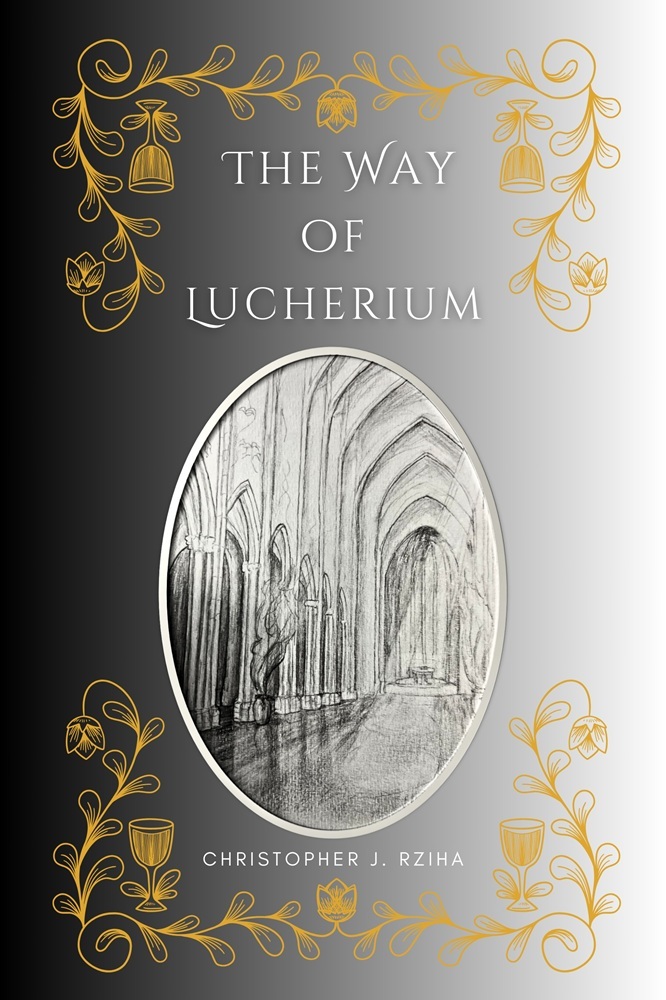
In the following article, you will find a brief, though tantalising, excerpt of Mr. Christopher Rziha’s new novel, The Way of Lucherium, as well as an interview with the author himself. Please enjoy the interview and explore The Way of Lucherium, published by En Route Books and Media, 2025. Available online
at https://enroutebooksandmedia.com/lucherium/
Sincerely,
The Editors
The Way of Lucherium
“The sun was beginning to rise, and the angled beams of light began to brighten and shift their
illuminating gaze from the grand hall’s center to its far end. Quite suddenly all three sets of doors
at the entrance of the chamber swung open, revealing rows upon rows of hooded figures, clad in
robes of silvery grey, many carrying torches and goblets. They processed silently into the
chamber, in columns as smooth and straight as the one below which Geoffrey was seated, until
they reached the foot of the table and the throne. Then, they filed off to either side of the central
pathway, forming ranks upon ranks which faced the dais and the jumbled, spiked mass looming
above it. Whether it was the uniform dress of the participants or some other trick Geoffrey did
not know, but his eyes seemed cloaked in a sort of mist, as if he couldn’t quite glimpse what was
really going on in front of him. A voice rang out from somewhere around Geoffrey, shattering
the stillness, and then another joined it, and another, until the hall was filled with song, strange
and sweet and sad, which at one moment seemed like the most beautiful piece of music in the
world, and the next moment seemed to not quite fit within Geoffrey’s mind no matter how hard
he tried, as if a certain chord or harmony was somehow off. The lyrics affected him the same
way too; Geoffrey could understand every word which was being chanted, but try as he might, he
couldn’t make heads nor tails of it. As the music swelled, several hooded figures plunged their
torches into the large bronze vessels arrayed about the hall, and which Geoffrey now realized
must hold some sort of incense, for upon receiving the flames, towering pillars of smoke began
to curl up toward the ceiling, filling the room with a sweet, piercing odor. The shafts of morning
light, now dancing through the columns of smoke, had reached the foot of the dais and
illuminated the book which sat upon the ancient table and the shattered throne behind it. As the
last of the grey-garbed figures took their places, the music swelled once more, and, out of the
most central doorway, there emerged a dozen more attendees, each one holding an exquisitely
carved goblet of their own and dressed in brilliant robes of white. Their heads were bare, and as
they passed him Geoffrey saw that among them were Xavier, Mariela, and Trentius. They were
the Elders of the Followers of Joaquin, Geoffrey could tell, and he was amazed how their eyes
seemed to shine almost as brightly as their robes, despite the shadows that lay around them. Two-
by-two they entered, almost gliding above the tiled floor as they crossed the length of the hall
and ascended the steps leading up to the dais, where they encircled the table and the book.
As suddenly as it had begun, the music died away, and the hall was deathly silent. One of the
Elders stepped forward and took up the book, and Geoffrey recognized Trentius’ voice, ringing
out clearly throughout the hall as he recited from what Geoffrey now realized was the other copy
of the Pontilux Poems, this one much larger and more ornate than any he had yet seen.
By Author Life and Light were formed
in Guide were Light and Life infused;
that both for glory might be used
by man, and union not abused.
That Story may be well performed
and man throughout might be transformed.
Yet now book burns and scroll is torn,
and Guide is cast out from his throne.
No Life is lived, no Light is shone,
but man in darkness bleeds alone;
for Darkness Life from Light has shorn,
and Darkness rules o’ertop the morn.
But still writes Author in the night,
that Guide in wisdom shall foresee
that Light and Life, though dimmed may be,
yet in their falling, rise shall He
and come victorious from the fight;
that in Him, might rest Life and Light.
So come now man to fallen Guide
within whom Life and Light yet hide,
that power new He might provide.
The words reverberated throughout the hall, the echo of each verse building upon the one that
came before it, until the entire chamber was filled with the voice of Trentius. As the final lines
rang out, the light from the rising sun rose up past the dais and its white-robed occupants and
finally illuminated the bulking mass of spikes which protruded from the wall and ceiling above
it. Geoffrey stared, struck dumb in awe and confusion, as he beheld for the first time what could
only be the skeleton of the Lord Joaquin, still impaled above his own throne by the dozens of
iron spears which had ended his life.
But that was not what rendered Geoffrey unable to speak.
As the first full rays of the day touched the body of Joaquin and the final words of Trentius faded
into nothingness, a writhing movement of what at first appeared to be a swarm of tiny insects
seemed to envelop the skeleton, twisting this way and that and so covering it that many of its
own kind were flung out into space where they plummeted to the ground below. And yet, as
Geoffrey looked more closely, he realized that it was not a horde of insects or vermin. Rather, it
was blood.“
Question: What inspired you to write The Way of Lucherium?
Response from Mr. Rziha: In short, the Holy Spirit, but a longer answer has to do with a conversation I once had with a professor, who told me that tragedy is the most enduring form of literature because it touches the deepest part of the human experience: loss. While brokenness and loss due to our sinful humanity is no doubt an integral part of every person’s experiences, the doctrine of Christ’s passion, death, and resurrection teaches us that there is a deeper reality upon which the human experience is founded: that of life, love, and unity. This is not to diminish the stark reality of sin and loss in any way -remember, Christ does not pull back from suffering, but rather immerses himself in it, and through his death, saves us- rather, it seeks to properly ‘order’ the experiences of suffering and loss within a wider cosmovision, one which recognizes that Christ died and rose for us, that he became man so that we might ultimately participate in the loving communion of the Trinity.
Q: As an author, how do you hope the work will be received?
R: You mean beyond ‘well?’ I hope it causes people to think about the ways that grace operates in their lives. The central question behind the work is: what if the realities of grace and sin, of deification and demonization, or sacraments and cultures of death, were made explicitly visible in our bodies, souls, and relationships? The work is classic tale of redemption and questing, that is true. However, it is also a ‘dramatization’ of St. Therese of Lisieux’s ‘little way’ and of St. Thomas Aquinas’ dictum that ‘grace perfects, but does not destroy, human nature.’ I hope people see it both ways.
Q: Of course, C.S. Lewis and J.R.R. Tolkien had differing ideas on symbolism and allegory. What are your own thoughts on the use of allegory in fiction?
R: In one sense, you could call my entire book an allegory on grace, although various mentors told me not to do so because large portions of the modern publishing world are scared of the word ‘allegory.’ While I did try to draw from both Tolkein and Lewis in developing my own symbolism, my greatest inspiration was undoubtedly the mystical theater of the Spanish Golden Age, where allegorical, mythical, and Biblical types and characters feature in spades. I believe that a character can be both a lively, strong-willed flesh and blood individual and a personification of a more ‘abstract’ virtue such as faith, wisdom, or loyalty; thus, every name in The Way of Lucherium hides a deeper meaning behind it. I won’t spill all of the beans, but I will give just one example: Trastaluche, the name given to the book’s fantastical world by its dictator, Trastivo, is a combination of ‘luche,’ or ‘light,’ and ‘trastornar,’ a Spanish verb that simultaneously means ‘to drive to insanity,’ ‘to disrupt,’ and ‘to scatter.’ In the Bible and throughout the Christian tradition, Satan is regularly referred to as a scatterer and a disrupter; thus, under the control of ‘Trastivo,’ ‘The Disrupter,’ the nation is named ‘Trastaluche,’ or ‘Disrupter of Light.’ This sort of symbolism inundates The Way of Lucherium to its very core.
Q: How did you develop your voice as an author? Did it take you some time to figure out the way you wanted the novel to sound?
R: I would say primarily through my reading, writing, and teaching as a graduate student. The plethora of literary works and voices I was exposed to implicitly helped me to form my own. In addition, while not required, the expectation as an MA candidate was that any student serious about applying for PhD programs should try to get at least one article published in a peer-reviewed journal. Although my academic and fictional voices are undoubtedly distinct in certain respects, the motivation to from the former no doubt contributed to the creation of the latter. As far as the ‘tone’ of the novel, I did spend a decent amount of time playing with the first chapter as a sort of ‘test case’ until I was satisfied with how it sounded. However, once the train of expression was established, I had no real trouble maintaining my voice throughout the work. I should stress, however, that the novel as a whole was very much an exercise in prayer and in letting the Holy Spirit speak through me. While I do not claim any infallible divine inspiration for my writing, I do give the credit and the glory to God.
Q: Many authors have considered their characters to be almost like living people, even friends. How do you approach your characters? Do they remain with you?
R: I’m not sure if I consider my characters as living people at this point, although if Geoffrey sticks around for a few more volumes, that may change. They definitely pop up in my life here and there, although I think that the storyline of The Way of Lucherium and its mystical and Eucharistic elements remain with me more. I generally approach my characters based on the lens of what I want them to convey; that is, based on to what extent they are a saint or a sinner (or both). While this is not the extent of the personality of each character, their ultimate identity informs their traits and actions to a great degree.
Q: Is there a writing regiment that you found to be particularly useful? Keeping a notebook, writing at the same time everyday, etc.?
R: I do keep a notebook to record key ideas for a specific project. As far as a writing regiment goes, I have two notes that I think will be of interest. First, I take walks to help me ‘talk out’ (or walk out, I guess) complicated plot points. Second, since I believe that good writing is a virtue that ought to be developed just like any other virtue -that is to say, once attained, it should be easy, prompt, and joyful- I write every day, no matter how I feel or what mood I am in. Obviously, some days are more productive than others, and when I write changes from day to day and week to week, but I believe it is essential that excellent writing be based not on emotion and situation but rather on the discipline and development of one’s person.
Q: Do you want your faith to be seen clearly in the writing, in the manner of Lewis? Or do you approach it more subtly? How do you hope your readers will engage with the question of faith throughout the novel?
R: In the manner of Lewis, no doubt, although even the more ‘obvious’ aspects of faith in the book contain more subtle allusions within them as well. I do hope that readers appreciate the way that faith deeply imbues the novel; however, I also encourage them to reflect on how the novel relates to their own faith life.
Q: Did your family play a role in the writing of the novel? How so?
R: Oh, definitely. To begin with, the education I received from my parents as a homeschooler is what laid the foundation for the development of my writing and thinking skills, especially in the realms of grace and nature. In addition, the holy examples that both my parents and siblings have provided me served as models for how grace manifests itself in and through the lives of different people. Finally, as my novel’s ‘acknowledgements’ page notes, many family members, including both parents and several brothers, read early versions of the novel and provided essential theological, literary, and grammatical feedback.
Q: I believe you also work on translations of some Spanish plays. Would you tell us a little bit about that process? Did translation influence the way that you write your own fiction?
R: Sure. Through the generous support of the de Nicola Center for Ethics and Culture at Nore Dame, I spent last summer translating three autos sacramentales, or Eucharistic dramas, from Spanish to English. The Eucharistic drama was a one-act play unique to Baroque Spain that featured allegorical, Biblical, mystical, hagiographical, mythical, secular, and historical characters and themes. It was written with the express purpose of exploring the social, spiritual, and political ramifications of the Eucharistic as the source and summit of the Christian life. The dramas I translated were written by the Baroque Spanish priest and playwright José de Valdivielso, whose most-read work is probably the approbation, or ecclesial approval, that he wrote for the second volume of Don Quijote. I would say that the translation, and my work on Spanish mystical literature and theater in general, influenced the novel in several ways. First, my inclusion of poetry throughout the work is due both to my love for Tolkein and for Spanish drama, which was composed in rhyming verse. Second, while my Eucharistic scenes are unique, they definitely draw inspiration from scenes in various Eucharistic dramas that characterize the peak of the spiritual life as a Eucharistic wedding banquet between divinity and humanity. Third, the whole central question of the interaction between grace and nature was a key question in the Spanish Baroque, and one that was regularly pondered in the Eucharistic drama.
Q: How about sequels? Would you like to write more in the world of Lucherium? Would you consider writing other works of fiction and can we look forward to any upcoming works?
R: While I leave any sequels in the hands of God, I would love to write more in the world of Lucherium. The ending of the current book allows it to function either as a standalone or as the first part of a longer series. I will not spoil its resolution for any potential readers, but two questions strike me as interesting points of departure for a second work. First, what does evangelization look like in the world of Lucherium, especially if the people being evangelized are, to quote Tevye quoting King David quoting Moses, ‘strangers in a strange land?’ Second, what are the ramifications of performing a seditious action that you know is good, true, and just, but which you also know will bring the wrath of an ungodly tyrant upon thousands of innocent lives? In answer to the second part of your question, I’d love to write other types of fiction, although I have nothing specific in mind at this point. Finally, in addition to a possible sequel, look for a critical volume of translated Eucharistic dramas to appear in the next year or so, if all goes well.
Q: Finally, do you have any advice for other would-be writers?
R: Two quick notes. First, focus on your prayer life. The inspiration for the first chapter of The Way of Lucherium came while I was praying in Mass after receiving Holy Communion. If you want to write literature that is good, true, and beautiful, it helps to be focused on the source of goodness, truth, and beauty. Second, as I noted above, good writing is a virtue, which means it is something you should be able to do easily, promptly, and joyfully. I’m not there yet, but I do know that, as with the development of any habit, discipline, intensity, and repetition are key. Write even when you don’t feel like it, or when there are distractions, or when you are in a period of spiritual or literary ‘dryness.’ It may not be good writing, but it will help you to become a good writer.
Thank you for reading and again, please be sure to check out Christopher Rziha’s novel, The Way of Lucherium, available through En Route Books and Media, 2025, https://enroutebooksandmedia.com/lucherium/

 The Locus
Leave a reply to Fantasy Author Interview: Christopher Rziha – Fellowship & Fairydust Cancel reply